Saturday, April 30, 2016

#Selfie

​This was the first project that I did in my beginning ceramics class. It as definitely a learning experience, and a challenging first project. I am grateful that this was our assignment, because tackling something so difficult right off the bat was a big confidence boost to the class. It set us up to believe in our own abilities as makers. Rob Lugo taught that class that I was in, and he said something to the effect of, We're doing this first because if you can make a head, then you know you can make anything. That was pretty empowering, and I thought that that was the main reason that I felt this project mattered to my development. I recently included some of these images in a presentation about my work, and afterwords my classmates mentioned some parallels between this and the work that I am making now. They encouraged me to dig deeper into why and what underlying theses have been continually relevant to me. 
So I began thinking about these connections. I made a self portrait because that was the assignment, but once the face was done, I had no interest in adding hair. I did not want to make a simulacral representation of myself that landed somewhere in the uncanny valley; it seemed both narcissistic and dull. And if I'm honest, I had spent hours meticulously sculpting my ear and could not bear to cover it up or try to replicate it. So instead, I began looking at images of termite hills, webbing roots, coral, dripping wax, and other organic formations. it did not seem to be filled with content at the time, these were simply images that I found formally compelling and relatable. It is not until later that I am starting to understand why these things stand out to me.

Growing up in rural northeastern Pennsylvania, I spent a lot of time in natural spaces. I drew distinctions between different kinds of "nature;" the nature that is a field of flowers is different than the nature that you find under a rock. And I was always more interested in the latter. It was more intimate; flowers are beautiful but impersonal. What I discovered by examining an anthill was much different than what I felt when walking through a field. I am more interested in the beautiful moments that can be found when you take the time to really get to know a space, or look in places that are not often looked at. That is not to say that I do not appreciate the beauty of a field of lowers or a stunning vista, because I certainly do. But this is not what I find myself collecting reference images of, and I think that's something for me to keep in mind. 
I am seeing that there are a lot of formal similarities between this piece and some of my more current work, though they are not similarities that I was aware of. Some of the networking linear elements that exist in much of my work are starting to emerge here, and the color palate is even similar to that in my Listening Device. I am very glad that I gave that presentation and that my classmates were generous with feedback; because of this experience, I am realizing that making connections between seemingly disparate work can help me understand more clearly what I am after. ​​

Friday, April 22, 2016

Neto-Inspired Copying

I did my presentation on the value of copying, and last week I posted about the work of Ernesto Neto. I would like to bring those things together right now. I am taking a class on installation art, and for our final project we had to do a site specific installation piece, document it, and then display the documentation alongside an artifact of the installation. My project was heavily influenced by Ernesto Neto's work, and there were prominent elements that one could argue were copied. For me, however, the project began to take on a life of its own and become different than Neto's work. There were marked similarities, such as the dangling pendulous forms that webbed together at the top, and the implication of physicality and interaction with an environment. But there were differences, things that I combined and transformed to make it my own. I exclusively used pantyhose, rather than the brightly colored synthetic fabrics that Neto often employs. While Neto's sculptures are influenced by minimalism and part of their aesthetic is the seamless manufactured look, mine were more crude. I intentionally showed the black stitches, highlighting the handmade-ness of the object. Instead of spices, I filled the hanging forms with stones. some became accordion-like instead of just the hanging sacks because of wire rings that I had sewn in. I first installed it in my apartment over my couch so as to address a domestic space rather than creating my own other-worldly environment. It changed the way I interacted with my living space for a few days, as I had to navigate around these things that were intent on hitting me. Because of this interaction, alongside my photo documentation  I installed a larger version of my Neto-inspired pendants over a bench in the hallway of Visual Arts Building. I am keeping an eye out over the next few days for how people interact with the piece.

I think that there is still a lot of room to move further away from my source material in this project. While I have added my own voice to the work, it is still very similar to Neto's installations. However, I do not feel uncomfortable with the similarities. I learned a lot from making this, and that is information that I can use later to further push my work so that my Neto influence is not so recognizable. This kind of copying was definitely a good step for me, though.

Pendants (Detail Shot), Nylon, Thread, Stones, Wire, Digital Print, 2016
Ernesto Neto 

Thursday, April 14, 2016

Ernesto Neto

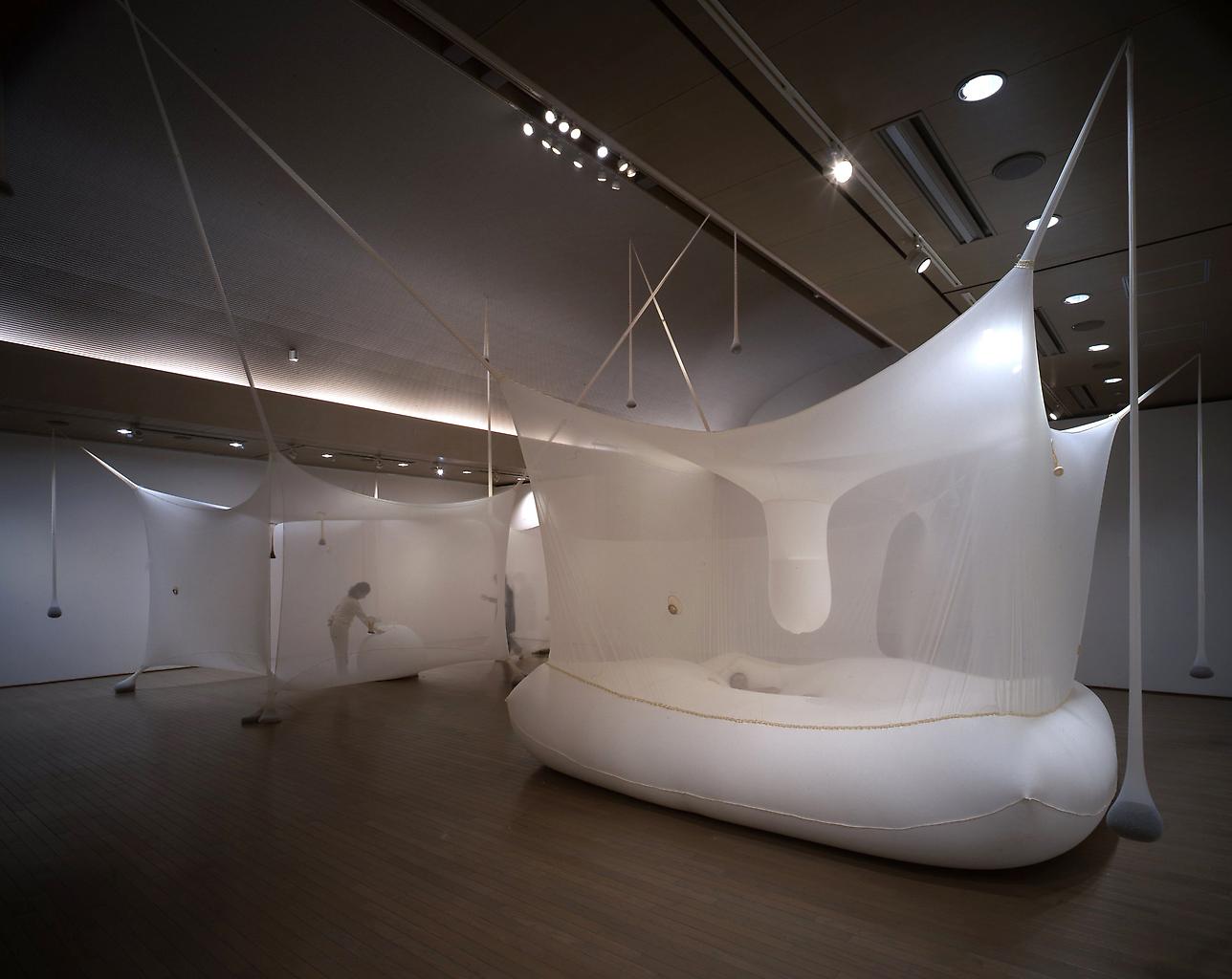
Ernesto Neto is a Brazilian installation artist who creates large-scale biomorphic immersive environments. Neto is interested in the boundaries of social, public and personal space, physical awareness, and engaging the senses. He uses crocheting (a technique he learned from his grandmother) to create narrow passageways, hoping to evoke intimacy as well as interaction. He also creates structure with stretchy stocking-like material filled with styrofoam pellets. Neto's pendulous forms often contain pungent spices in an attempt to further evoke the senses. He does not care to layer his work with social or political subtexts; rather, he is interested in how physical experience can bring out commonalities among otherwise different people. His spaces are sometimes tricky to navigate and they can provide adults with sensations that they might otherwise not experience. They provide a space where one can stop thinking, a break that Neto believes is important and healthy, and instead focus on an increased awareness of the physical body.

Ernesto Neto is one of my favorite artists. I was first drawn to his work because I think that it is incredibly beautiful. I would love to have the chance to be inside one of his crocheted corridors or lounge in a giant pillowy mass. But the more I look at his work, the more important it seems to me. I also believe in the importance of quieting the mind and listening to the body. I think that as a society who does most of its work on paper or computers, it is easy to lose touch with the physical body. Perhaps this is a large factor in out nation's obesity plight. Little importance is put on physical activity for the average adult,
and most people live very sedentary lives. This is why I think that Neto's installations continue to be competing beyond their appearance. They give the viewer a chance to get in touch with their own physicality.


Wednesday, April 6, 2016

Adventure Playgrounds

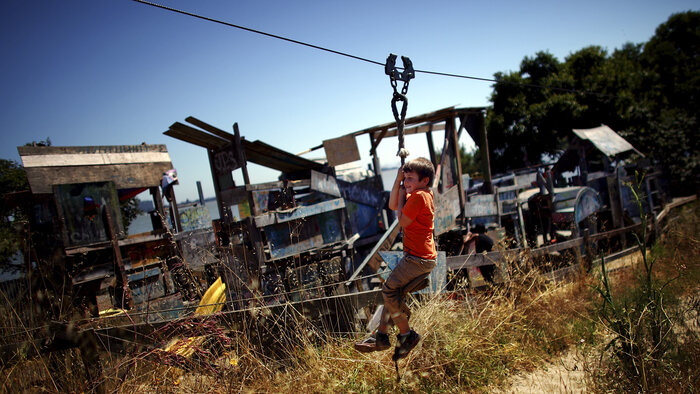
For my literature review, I researched and wrote about adventure playgrounds. Adventure playgrounds were first created in Europe when it was observed that children likes to play on bombed sites and practically everywhere other than designated playgrounds. These playgrounds are in response to adult-made prescriptive structures, which children quickly grow bored with. instead, these are spaces where children are allowed to build and alter their own structures, cook over fires, get in the mud, and a variety of other activities that are normally prohibited in playspaces. These dangers are counteracted by the presence of trained adults who fill the role of an unobtrusive observer, stepping in only when needed. This way, children can engage in creative and free play with managed risk, which is developmentally advantageous. While widespread in Europe, these adventure playgrounds never really caught on in the United States. Concerns about safety and liability have stifled their popularity, and there are only a few of these unstructured playgrounds in the country. I find this interesting, and perhaps unfortunate.
An adventure playground in Berkeley, CA–one of the very few in the country.

This raises a lot of questions for me about personal responsibility and trends in parenting styles. Perhaps Americans are too reliant upon institutional rules to keep them safe; I think that this may lead to negative consequences for our citizens. There is a personal example that comes to mind for me. I grew up in a rural area and was raised in a family where hunting was prevalent. As a child, I took a class with my dad about gun safety and was taught how to properly handle firearms. Last year, I went to a shooting range with my boyfriend and one of our close friends. This friend had never held a gun before and was an advocate of gun control. When it was his turn to shoot, I started to see why. Because he had no experience and was not used to handling anything that was dangerous, he was treating the loaded gun in a very lax fashion. It was terrifying. Because his world was very safe and sheltered, he did not have a strong sense of responsibility for the safety of those around him. This was a very unsettling experience for me, though not because I was concerned he was going to accidentally shoot me. I was very troubled that someone who I thought of as very intelligent and capable could have so little concept of danger. Perhaps our society has put so much emphasis on safety that we are actually doing people a disservice. If a child falls on a playground and lands in a soft bed of rubber chunks, maybe he will never learn that roughhousing can lead to a scraped knee-or worse. I do not think that we are doing our children any favors by presenting them with sterilized constructed environments with no possible risk. We show them a false and artificial world that is not the actual world we live in.

True Story

I have been listening to a lot of the same music lately. This morning, I went to the gym and put on my gym playlist. I found myself being fueled by annoyance at the repetitiveness of the sound rather than the beats. I waled home to get a change of clothes, listening to another tired playlist. I needed something different; it was driving me crazy. I decided that I need to take a break from music altogether, but also wanted something to take my mind off of the cold and wind. I settled on listening to a podcast. I sometimes listen to a podcast called "True Story" where people share stories of events that have happened to them. Some are funny, sad or compelling. I selected one at random to keep me company on my walk to class. This particular story was a little more abstracted, not so much about a monumental event but about how a small event carried a lot of meaning. The guy who was telling the story talked about moving out of his house without wanting to offend his roommates, and then being in a hurry to be on time for a new job. There was nothing monumental about the story, but he talked about a realization that he came to through a series of events. He spoke about worrying and stressing out about the struggle to meet the expectations that you expect others to have for you, and how that can leave you spread thin and out of touch with yourself. This resonated with me because that is something that I often do, and it is unsustainable. In an effort to please everyone around you and never disappoint anyone, it is easy lose track of what you want. And often, others have less expectation of us than we might assume. It is easy to forget that everyone else has a busy schedule as well and they do not always have time to think about whether you are doing well enough. This brings me back to the Mary Oliver poem that I have talked about before, Wild Geese. "You do not have to be good... you only have to let the soft animal of your body love what it loves." I think that it is important to remember to take care of yourself and to know when you need to put yourself first. I know that this is something that I struggle with often.

From Mother to Daughter

I have seen Sarah Kay's spoken word pice, If I Should Have a Daughter, before we watched it in class. I found it just as powerful watching it again after already having seen it. I think that this is a beautiful sentiment from mother to daughter about kindness, tenderness and strength. It reminded me of Jamaica Kincaid's poem Girl; these pieces have striking similarities as well as very notable differences. Both chronicle the lessons that a mother wishes to pass on to her daughter in hopes of preparing her for a successful life and providing tools to cope with the world around them. The tenor is much different, however, and this difference is made greater because of who is writing/speaking the poem. Kay's message is for her (potential) daughter and is founded on idealism. She paints an idyllic picture of nurture and love that she intends to provide her daughter. She is emotional, and she makes us feel emotional through her beautiful use of metaphor and descriptive language and she professes her intentions for motherhood. In contrast, Kincaid recounts the many things that her mother instructed her to do while she was growing up. While surely her mother intended to strengthen and help her daughter, it was presented in matter-of-fact criticisms and orders. There is an edge to these lessons, giving right and wrong ways of being. These are prescriptive lessons that teach how to fit into an existing and seemingly repressive social structure, pruning the daughter to the right shape. Kay's lessons are not like this. They are more abstract and present the world as a place that her daughter can impact. These lessons are more empowering. This makes me think about privilege and advantage. While Kincaid's mother's lessons seem harsh to us, I believe that mothers do what they think is best for their children. It is interesting to think about how each of these mothers see themselves in a larger social structure and how that may impact how they think about their daughters.

Monday, April 4, 2016

"My 12 Pairs of Legs"

Aimee Mullins, a woman who is an athlete, actor, and walks on prosthetic legs, gives a beautiful TED talk about disability. She redefines what it means to be disabled, transforming her disability into ability called "My 12 Pairs of Legs." She talks about children and how from an early age, they are taught to be fearful of disability and restricted from asking questions. Mullins is attempting to turn that upside down, inviting people to acknowledge and discuss. She talks about her prosthetic legs, reframing them as objects of empowerment that can elevate her body rather than hold it back. She talks about transforming something that might make people fearful and instead invites them to look. In showing her various pairs of legs that have been made for her, she touches on whimsy and its importance. This struck a cord with me. What does it mean to be serious, and when is seriousness important for respect and dignity? I think that when I think about disability, it is somber and dark seeming. But why does it have to be dark? Why can’t it be seen as an opportunity to be whimsical? Of course, not all disabilities are equal and perhaps some have more room for whimsy than others. But this made me reconsider my default, that maybe I am doing disability a disservice by assuming that it has to be a sobering encounter. Maybe acknowledgement is one of the most important things, because it is what allows you to move past the negative and find beauty in a situation. I think that this can be applicable outside of the context of disability. To me, this illuminated the difference of acknowledging and dwelling. I think that this is a really empowering talk by a powerful woman who makes a moving case for reframing what seems to be negative and turning it into something incredible.