Saturday, April 30, 2016

#Selfie

​This was the first project that I did in my beginning ceramics class. It as definitely a learning experience, and a challenging first project. I am grateful that this was our assignment, because tackling something so difficult right off the bat was a big confidence boost to the class. It set us up to believe in our own abilities as makers. Rob Lugo taught that class that I was in, and he said something to the effect of, We're doing this first because if you can make a head, then you know you can make anything. That was pretty empowering, and I thought that that was the main reason that I felt this project mattered to my development. I recently included some of these images in a presentation about my work, and afterwords my classmates mentioned some parallels between this and the work that I am making now. They encouraged me to dig deeper into why and what underlying theses have been continually relevant to me. 
So I began thinking about these connections. I made a self portrait because that was the assignment, but once the face was done, I had no interest in adding hair. I did not want to make a simulacral representation of myself that landed somewhere in the uncanny valley; it seemed both narcissistic and dull. And if I'm honest, I had spent hours meticulously sculpting my ear and could not bear to cover it up or try to replicate it. So instead, I began looking at images of termite hills, webbing roots, coral, dripping wax, and other organic formations. it did not seem to be filled with content at the time, these were simply images that I found formally compelling and relatable. It is not until later that I am starting to understand why these things stand out to me.

Growing up in rural northeastern Pennsylvania, I spent a lot of time in natural spaces. I drew distinctions between different kinds of "nature;" the nature that is a field of flowers is different than the nature that you find under a rock. And I was always more interested in the latter. It was more intimate; flowers are beautiful but impersonal. What I discovered by examining an anthill was much different than what I felt when walking through a field. I am more interested in the beautiful moments that can be found when you take the time to really get to know a space, or look in places that are not often looked at. That is not to say that I do not appreciate the beauty of a field of lowers or a stunning vista, because I certainly do. But this is not what I find myself collecting reference images of, and I think that's something for me to keep in mind. 
I am seeing that there are a lot of formal similarities between this piece and some of my more current work, though they are not similarities that I was aware of. Some of the networking linear elements that exist in much of my work are starting to emerge here, and the color palate is even similar to that in my Listening Device. I am very glad that I gave that presentation and that my classmates were generous with feedback; because of this experience, I am realizing that making connections between seemingly disparate work can help me understand more clearly what I am after. ​​

Friday, April 22, 2016

Neto-Inspired Copying

I did my presentation on the value of copying, and last week I posted about the work of Ernesto Neto. I would like to bring those things together right now. I am taking a class on installation art, and for our final project we had to do a site specific installation piece, document it, and then display the documentation alongside an artifact of the installation. My project was heavily influenced by Ernesto Neto's work, and there were prominent elements that one could argue were copied. For me, however, the project began to take on a life of its own and become different than Neto's work. There were marked similarities, such as the dangling pendulous forms that webbed together at the top, and the implication of physicality and interaction with an environment. But there were differences, things that I combined and transformed to make it my own. I exclusively used pantyhose, rather than the brightly colored synthetic fabrics that Neto often employs. While Neto's sculptures are influenced by minimalism and part of their aesthetic is the seamless manufactured look, mine were more crude. I intentionally showed the black stitches, highlighting the handmade-ness of the object. Instead of spices, I filled the hanging forms with stones. some became accordion-like instead of just the hanging sacks because of wire rings that I had sewn in. I first installed it in my apartment over my couch so as to address a domestic space rather than creating my own other-worldly environment. It changed the way I interacted with my living space for a few days, as I had to navigate around these things that were intent on hitting me. Because of this interaction, alongside my photo documentation  I installed a larger version of my Neto-inspired pendants over a bench in the hallway of Visual Arts Building. I am keeping an eye out over the next few days for how people interact with the piece.

I think that there is still a lot of room to move further away from my source material in this project. While I have added my own voice to the work, it is still very similar to Neto's installations. However, I do not feel uncomfortable with the similarities. I learned a lot from making this, and that is information that I can use later to further push my work so that my Neto influence is not so recognizable. This kind of copying was definitely a good step for me, though.

Pendants (Detail Shot), Nylon, Thread, Stones, Wire, Digital Print, 2016
Ernesto Neto 

Thursday, April 14, 2016

Ernesto Neto

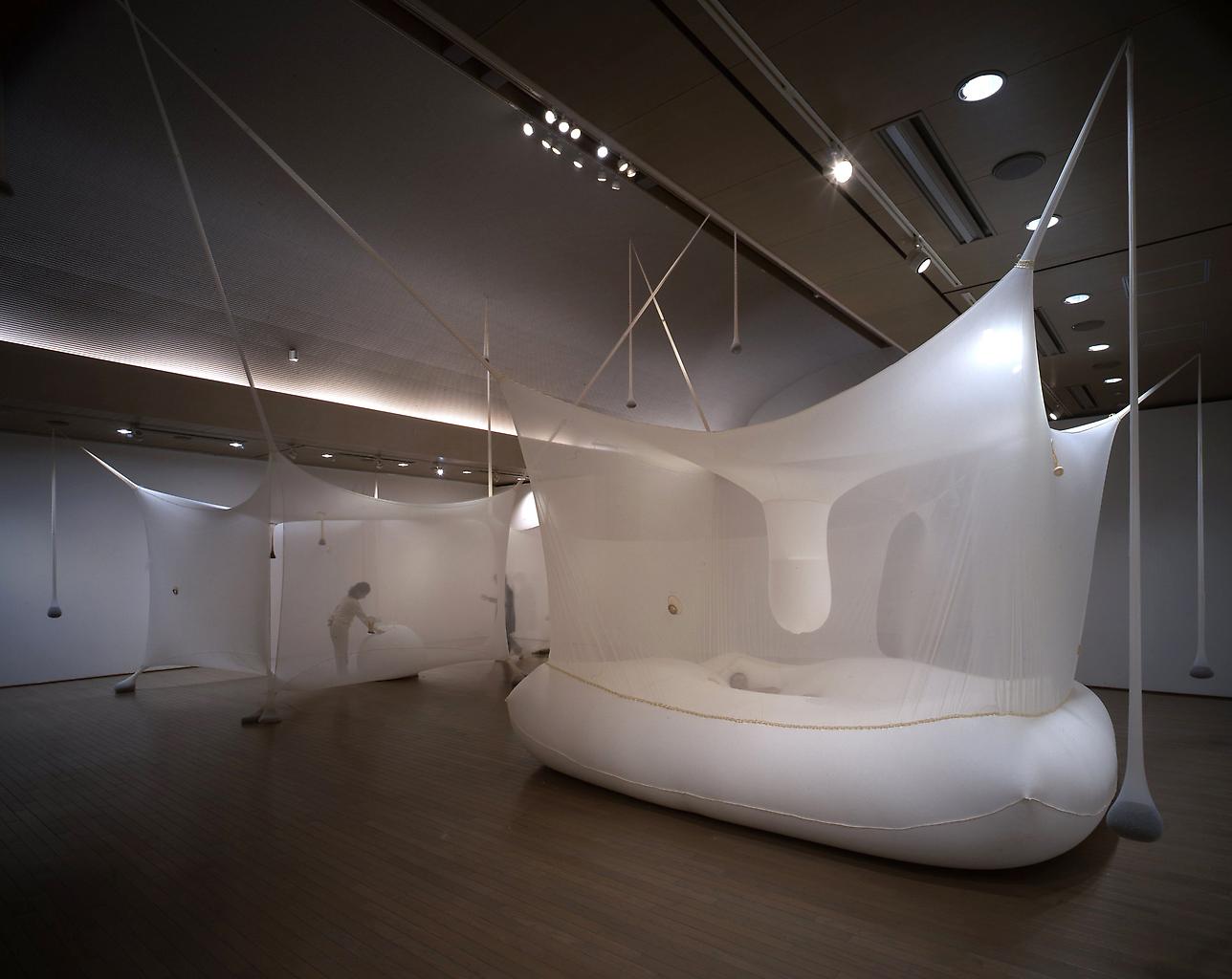
Ernesto Neto is a Brazilian installation artist who creates large-scale biomorphic immersive environments. Neto is interested in the boundaries of social, public and personal space, physical awareness, and engaging the senses. He uses crocheting (a technique he learned from his grandmother) to create narrow passageways, hoping to evoke intimacy as well as interaction. He also creates structure with stretchy stocking-like material filled with styrofoam pellets. Neto's pendulous forms often contain pungent spices in an attempt to further evoke the senses. He does not care to layer his work with social or political subtexts; rather, he is interested in how physical experience can bring out commonalities among otherwise different people. His spaces are sometimes tricky to navigate and they can provide adults with sensations that they might otherwise not experience. They provide a space where one can stop thinking, a break that Neto believes is important and healthy, and instead focus on an increased awareness of the physical body.

Ernesto Neto is one of my favorite artists. I was first drawn to his work because I think that it is incredibly beautiful. I would love to have the chance to be inside one of his crocheted corridors or lounge in a giant pillowy mass. But the more I look at his work, the more important it seems to me. I also believe in the importance of quieting the mind and listening to the body. I think that as a society who does most of its work on paper or computers, it is easy to lose touch with the physical body. Perhaps this is a large factor in out nation's obesity plight. Little importance is put on physical activity for the average adult,
and most people live very sedentary lives. This is why I think that Neto's installations continue to be competing beyond their appearance. They give the viewer a chance to get in touch with their own physicality.


Wednesday, April 6, 2016

Adventure Playgrounds

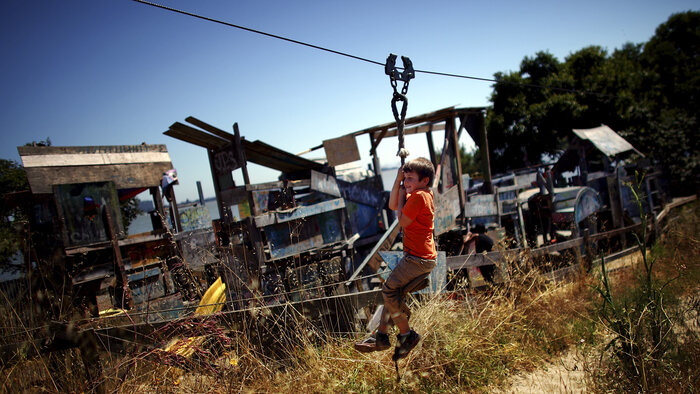
For my literature review, I researched and wrote about adventure playgrounds. Adventure playgrounds were first created in Europe when it was observed that children likes to play on bombed sites and practically everywhere other than designated playgrounds. These playgrounds are in response to adult-made prescriptive structures, which children quickly grow bored with. instead, these are spaces where children are allowed to build and alter their own structures, cook over fires, get in the mud, and a variety of other activities that are normally prohibited in playspaces. These dangers are counteracted by the presence of trained adults who fill the role of an unobtrusive observer, stepping in only when needed. This way, children can engage in creative and free play with managed risk, which is developmentally advantageous. While widespread in Europe, these adventure playgrounds never really caught on in the United States. Concerns about safety and liability have stifled their popularity, and there are only a few of these unstructured playgrounds in the country. I find this interesting, and perhaps unfortunate.
An adventure playground in Berkeley, CA–one of the very few in the country.

This raises a lot of questions for me about personal responsibility and trends in parenting styles. Perhaps Americans are too reliant upon institutional rules to keep them safe; I think that this may lead to negative consequences for our citizens. There is a personal example that comes to mind for me. I grew up in a rural area and was raised in a family where hunting was prevalent. As a child, I took a class with my dad about gun safety and was taught how to properly handle firearms. Last year, I went to a shooting range with my boyfriend and one of our close friends. This friend had never held a gun before and was an advocate of gun control. When it was his turn to shoot, I started to see why. Because he had no experience and was not used to handling anything that was dangerous, he was treating the loaded gun in a very lax fashion. It was terrifying. Because his world was very safe and sheltered, he did not have a strong sense of responsibility for the safety of those around him. This was a very unsettling experience for me, though not because I was concerned he was going to accidentally shoot me. I was very troubled that someone who I thought of as very intelligent and capable could have so little concept of danger. Perhaps our society has put so much emphasis on safety that we are actually doing people a disservice. If a child falls on a playground and lands in a soft bed of rubber chunks, maybe he will never learn that roughhousing can lead to a scraped knee-or worse. I do not think that we are doing our children any favors by presenting them with sterilized constructed environments with no possible risk. We show them a false and artificial world that is not the actual world we live in.

True Story

I have been listening to a lot of the same music lately. This morning, I went to the gym and put on my gym playlist. I found myself being fueled by annoyance at the repetitiveness of the sound rather than the beats. I waled home to get a change of clothes, listening to another tired playlist. I needed something different; it was driving me crazy. I decided that I need to take a break from music altogether, but also wanted something to take my mind off of the cold and wind. I settled on listening to a podcast. I sometimes listen to a podcast called "True Story" where people share stories of events that have happened to them. Some are funny, sad or compelling. I selected one at random to keep me company on my walk to class. This particular story was a little more abstracted, not so much about a monumental event but about how a small event carried a lot of meaning. The guy who was telling the story talked about moving out of his house without wanting to offend his roommates, and then being in a hurry to be on time for a new job. There was nothing monumental about the story, but he talked about a realization that he came to through a series of events. He spoke about worrying and stressing out about the struggle to meet the expectations that you expect others to have for you, and how that can leave you spread thin and out of touch with yourself. This resonated with me because that is something that I often do, and it is unsustainable. In an effort to please everyone around you and never disappoint anyone, it is easy lose track of what you want. And often, others have less expectation of us than we might assume. It is easy to forget that everyone else has a busy schedule as well and they do not always have time to think about whether you are doing well enough. This brings me back to the Mary Oliver poem that I have talked about before, Wild Geese. "You do not have to be good... you only have to let the soft animal of your body love what it loves." I think that it is important to remember to take care of yourself and to know when you need to put yourself first. I know that this is something that I struggle with often.

From Mother to Daughter

I have seen Sarah Kay's spoken word pice, If I Should Have a Daughter, before we watched it in class. I found it just as powerful watching it again after already having seen it. I think that this is a beautiful sentiment from mother to daughter about kindness, tenderness and strength. It reminded me of Jamaica Kincaid's poem Girl; these pieces have striking similarities as well as very notable differences. Both chronicle the lessons that a mother wishes to pass on to her daughter in hopes of preparing her for a successful life and providing tools to cope with the world around them. The tenor is much different, however, and this difference is made greater because of who is writing/speaking the poem. Kay's message is for her (potential) daughter and is founded on idealism. She paints an idyllic picture of nurture and love that she intends to provide her daughter. She is emotional, and she makes us feel emotional through her beautiful use of metaphor and descriptive language and she professes her intentions for motherhood. In contrast, Kincaid recounts the many things that her mother instructed her to do while she was growing up. While surely her mother intended to strengthen and help her daughter, it was presented in matter-of-fact criticisms and orders. There is an edge to these lessons, giving right and wrong ways of being. These are prescriptive lessons that teach how to fit into an existing and seemingly repressive social structure, pruning the daughter to the right shape. Kay's lessons are not like this. They are more abstract and present the world as a place that her daughter can impact. These lessons are more empowering. This makes me think about privilege and advantage. While Kincaid's mother's lessons seem harsh to us, I believe that mothers do what they think is best for their children. It is interesting to think about how each of these mothers see themselves in a larger social structure and how that may impact how they think about their daughters.

Monday, April 4, 2016

"My 12 Pairs of Legs"

Aimee Mullins, a woman who is an athlete, actor, and walks on prosthetic legs, gives a beautiful TED talk about disability. She redefines what it means to be disabled, transforming her disability into ability called "My 12 Pairs of Legs." She talks about children and how from an early age, they are taught to be fearful of disability and restricted from asking questions. Mullins is attempting to turn that upside down, inviting people to acknowledge and discuss. She talks about her prosthetic legs, reframing them as objects of empowerment that can elevate her body rather than hold it back. She talks about transforming something that might make people fearful and instead invites them to look. In showing her various pairs of legs that have been made for her, she touches on whimsy and its importance. This struck a cord with me. What does it mean to be serious, and when is seriousness important for respect and dignity? I think that when I think about disability, it is somber and dark seeming. But why does it have to be dark? Why can’t it be seen as an opportunity to be whimsical? Of course, not all disabilities are equal and perhaps some have more room for whimsy than others. But this made me reconsider my default, that maybe I am doing disability a disservice by assuming that it has to be a sobering encounter. Maybe acknowledgement is one of the most important things, because it is what allows you to move past the negative and find beauty in a situation. I think that this can be applicable outside of the context of disability. To me, this illuminated the difference of acknowledging and dwelling. I think that this is a really empowering talk by a powerful woman who makes a moving case for reframing what seems to be negative and turning it into something incredible.


Artist Talk


This afternoon, I went to a lecture that my professor, Cristen Millet, was giving in Borland building. She talked about her work as a professional artist, telling us conceptual and historical backgrounds that are the underlying basis for her current work. Much of her art is about medical history, specifically as it relates to the female body and reproductive system. This was interesting from an artistic, historical and social perspective. Much of the scientific speculation of early medical studies was entirely wrong; for example, one medieval diagram depicts a seven-chambered uterus, each chamber designated male, female or hermaphroditic. The men who were proposing this theory of female anatomy had never actually seen a uterus; this was in a pre-dissection era, and the diagrams were based entirely upon speculation. It seems strange to me that this theory would be developed with so little basis. What is far more alarming, however, is the fact that this was considered factual with absolutely no evidence to back it up. While we surely do not have anything so absurd in modern textbooks and historical medical practices seem barbaric to our modern sensibilities, I believe that it is important to keep occurrences such as these present in our minds. People tent to regard anything that is placed under the umbrella of “science” as indisputable fact, and this is simply not true. For all of the vast knowledge that humans have acquired about the world, there is so much more that is beyond out understanding. In the future, people will certainly look back at our contemporary beliefs and some of them will be seen as misguided or wrong. I am not saying that scientific advancement is unimportant. What I do strongly believe, though, is that it is important for people to have a questioning mind. Just because knowledge is “institutional” does not mean that it is undoubtedly correct. In formal education settings like universities, “critical thinking” is encouraged, but sometimes critical thinking is presented as the ability to solve complicated or creative problems. I propose that critical thinking means to be critical of what you hear–to question and doubt and be skeptical. In that way, I think that critical thinking is vital.

Exhibiting Culture... (Cultures?)


Last week, I read a chapter out of the book Exhibiting Cultures: They Poetics ad Politics of Museum Display that was titled “Exhibiting Intention: Some Preconditions of the Visual Display of Culturally Purposeful Objects.” This chapter touched on many of the problems surrounding museum didactics (labels for exhibits). The author addresses the “space between object and label.” There are three participants in the museum exhibition of cultural artifacts: the original maker of the object, the exhibitor, and the viewer. The space between label and object is where these roles converge. While I was reading this article, I could appreciate the viewpoints that the author was creating, that labeling and exhibiting an object may lead to a problematic representation of a culture, and his proposed solution was compelling. Labels are interpretive rather than descriptive; they do not describe the physical properties of an object, but rather create a story around the object by making a curatorial decision about what facts are appropriate to accompany the object. While we are conditioned to see museums as temples of knowledge and truth, the fact of the matter is that the information that is provided was selected and edited by an exhibitor. They have decided what information is best to tell about the object as an outsider to that culture, unable to truly understand the nuances of that object’s role. The author goes on to point out that when a viewer is surrounded by an exhibit displaying the artifacts of one culture, they are left to construct (with the guidance of the exhibitor) an incomplete story of otherness. This is problematic because it does not draw attention to the cultural uniqueness of the viewer’s own experience. Others have cultures, the viewer’s own culture is the norm. Instead, the author proposes showing artifacts from several different cultures that are similar in function or are put in relevant context. This cues the viewer to acknowledge their own cultural bias and is less alienating to other groups. I believe that this is a compelling argument, and I surely would enjoy an exhibit that put Picasso’s paintings next to the African masks that they were inspired by. This would provide a truer version of history. It does make me wonder, however, how one would “correctly” go about learning about a specific people. Is there no place in a fair world for a culturally specific exhibition? While there are clearly problematic aspects to this concept, it seems as though there is no ideal way to learn about a group of people’s way of life without living there for extended periods of time. I would be interested in hearing a proposed solution of how to approach this in a way that is feasible and reasonable.  

Wednesday, March 2, 2016

Judith Scott


This semester, I am taking a studio class about installation art. We are currently dong a collaborative piece; I have three group members to help me address a very strange and dirty basement space. We have created a narrow passageway that we plan to fill with a variety materials to create a space of bodily awareness. The floor will be made up of bound together soft materials to create an unstable surface upon which to walk, while the ceiling will be lowered by draped material through which the participant will have to navigate. One of my main inspirations for this project is Judith Scott, and artist who works by binding together materials. When I was explaining this to my group and showing them images, I felt a small personal dilemma. Judith Scott has Down Syndrome, but despite her disability makes beautiful work that I find compelling. For some reason, when I was showing my group images of her work, I was unsure whether I should mention the fact that the artist is disabled. I felt a little embarrassed, or perhaps ashamed, that I was struggling with this. It should not matter, should it? When I first was shown her work, I did not know about her disability and I loved it. I went to the library and checked out a book about her, and it was only after flipping though that book that I discovered that the artist had Down Syndrome. For some reason, I felt like that changed her work. This is a concept that I am still struggling with. On the one hand, perhaps art should be appreciated without any importance put on the identity of the artist. But another part of me feels that where the artist is coming from in important, that it adds content to the work. But I feel a little uncomfortable that my first reaction to the work was that disability meant lack of intention; that is a very closed minded assumption for me to have made. Scott’s experience are no less legitimate than mine, and neither is her work. There is no prerequisite for being an artist. And I think that it is limiting if the discussion surrounding her work is focused on her disability rather than her ability. Her work is beautiful, with no conditions, and I hope that my group’s basement installation can come close to embodying what I love about Scott’s work.  


Friday, February 26, 2016

Laramie


The Laramie Project is different than many other pieces of literature I have read. Part of its potency is the fact that it is a true story. It is difficult to imagine such a thing actually happening to a person. Though I am from Pennsylvania, I felt as though I could relate to Laramie, or at least the way that it was being portrayed. I am from a rural area and went to school in a small town full of conservative people. My own family is conservative, and I was raised to hold many conservative values. In a college setting, being conservative isn’t particularly popular. Many people, especially those who have had primarily liberal influences in their lives, bring a lot of assumptions to the table; conservatives are racist, sexist, uneducated, backwards, and intolerant. It can be frustrating if these characteristics are assumed of you, and it can be difficult to not feel defensive. I think that because of this experience, I had very mixed feelings about some of the interviews that were portrayed. On the one hand, it is often true that many people who live in rural areas have less exposure to diversity. People generally feel uncomfortable with things that are unfamiliar to them; this is human nature. That is not to excuse prejudice or discrimination by any means, but there is a difference between excusing and empathizing. I believe that you can condemn a belief or a behavior without condemning a person. When watching these interviews and hearing an old white woman proclaim that her town is “live-and-let-live,” it is easy to “call bullshit” on that remark and talk about privilege and ignorance. And I think that it is important that we recognize the implications of that phrase that was repeated over and over, because as one character said, live-and-let-live really means don’t tell me and I wont beat you. It is the same principle as don’t-ask-don’t-tell. And this is not an acceptable norm. But I also believe that saying this does not mean that this woman is a bad person. Perhaps she does not have an ideal perspective on dealing with people who are different than her. But I think that it is important for us to acknowledge our own privilege in having enough exposure and education to be able to analyze that this is a problematic statement.

Friday, February 19, 2016

Wild Geese

Last week, I went to the library to do some research. I left with an absurd number of books, enough that I had to call my boyfriend to come pick me up because I couldn't carry them home. Most of them were about art, artists and design–Antony Gormely, Eva Hesse, Louise Bougouise, South American Folk Pottery, African Basketry, and other books of that nature. But when I was wandering around the stacks of the library, I took a detour and picked up a poetry book.
Last summer, I was struggling with a lot of anxiety. I have a friend that I would talk to about it, and she was going through some similar stuff. She read this poem to me, and I was enraptured with it. It made me feel more calm and at ease.
Towards the end of the summer, both of us had to go back to school. One morning, we were supposed to meet to work out, but she showed up hours late. When she finally got to my house, she had a very large brown book with her. She told me that she wanted to show me what it was, so we both went to my room and sat down on my bed to get some privacy from everyone else in my house. When she opened it up and began flipping the pages and talking, I started getting choked up. She had written out poems and quotes o the pages that she thought might help me when I was feeling like things were getting bad. There were drawings and photos of things that I liked. It was all so beautifully handmade. And one of the pages was fully dedicated to that poem, Wild Geese by Mary Oliver.

I have been feeling kind of lost and stressed out lately, and I’ve been coming back to that poem. As I was wandering through the library, it occurred to me that there was probably a book of her poems somewhere. Sure enough, I found a nice thick purple one. I haven’t had a chance to read all of it, but I have read a few and they’re wonderful. And I keep reading Wild Geese.


Friday, February 12, 2016

The Sectet Space


As I got up the last stair–or ladder rung, more like, these stairs are so step–I was surprised to see another girl sitting in my space. I shouldn’t have been; I know that everyone else knows about the attic space. Lots of people go up there, but it’s one of those places that when you are there feels secret, like you are the only person who has discovered this hiding place. I felt annoyed, because I was going there to be alone. She was infringing upon my privacy. Then I realized that I was infringing on her privacy, but it would have been too awkward to leave. I had my sketchbook and pencil case in my hands, giving away my intentions. Do you mind if I stay up here? I asked. No, I’m just working on my homework. I knew she minded, but I stayed anyway. It was hot up there, and I started feeling drowsy. I could see people walking around the studio, working or talking or whatever they were doing, and I was glad to have escaped the noise. I settled into the chaise that was up there for no apparent reason, probably used for figure drawing models decades ago. I knew my professor had no reason to venture up here, though I couldn’t help feeling slightly uneasy that I was going to be caught. It was a work day, but I was still supposed to be in class actually working. I tried to decompress, get rid of my feeling of overwhelmed-ness. I closed my eyes and tried to forget I wasn’t alone, trying to brainstorm what I was going to talk about during my next class. I had to have a plan of what my next project was going to be, but I felt directionless. My classes have lost most of their structure and are open to whatever I want to do. This sounds great and liberating and free, to make whatever you want. But what if you don’t have a plan? That freedom becomes a bit overwhelming. It is directionless, and there is only so long you can spend in the studio attic. 

Friday, February 5, 2016

Navigating Personal Writing


Over the past few weeks, I have been trying to write an artist statement. This has turned out to be really difficult. I have realized that writing truthfully about my own experiences, thoughts, and art is challenging in ways that I did not expect.  I found this to be true for my passion literacy narrative as well. I generally think of myself as a capable writer, and I thought that both of these tasks would be relatively easy. In the last four years that I have spent in college, I have done a lot of writing, but most of it has been research and analysis based, not personal. Any sort of personal exploration or explanation that I have done for school has been verbal, and there hasn’t been that much of it. For both my narrative essay and my artist statement, one of the things that I was realizing was that I did not totally understand what I wanted to say because it was something that I was trying to figure out myself. Having these writing assignments has forced me to analyze my studio practice and motivations for making in more depth than I was doing on my own. While it was difficult and I think that my writings were just a starting paint for me, I think that taking on this task helped me to start identifying patterns, and this is something that is really useful to me. In the class for which I am writing the artist statement, we are also doing an exercise where we interview each other and then write an artist statement for another person based on their interview. Though I was skeptical at first, this ended up being very helpful to me. When I was being interviewed, the words flowed more easily because I was not trying to make them sound right and I want over-thinking it. I think that I learned a lot from this artist statement that was written about me, and I am hoping that I can synthesize that, my narrative, and my old statement together to begin creating a better statement to work off of. I think that I need to start doing more personal writing so that I flows more easily, as this ability will be important to me down the line to benefit my career. I also want to be able to write about my work in a compelling way, both for professional and personal reasons. 

Friday, January 29, 2016

Don't Be a Slut


I grew up with a lot of male influence in my life. I have three brothers, my mom had five, and most of them had sons. From a young age, I was surrounded by boys all of the time. When people find out I have three brothers, they often make comments as though they are sorry for me, that it must have been hard growing up like that with no sisters. And I never understood this. I love my brothers, and we get along great. I did not understand why everybody assumed that gender was one of the defining characteristics of a good sibling relationship. Now that I’m older, I can see that if I had a sister, perhaps we could connect in ways where there are barriers with my brothers. They surely have aspects of their relationships with each other that I am not a part of. While we might work out in the garage together once in a while, we aren’t gym buddies. And when I want to go shopping, I usually go with my mom or a friend instead of them. But these are activity preferences. We all act pretty similarly, and I generally don’t think about it in gendered terms. And I think that for the most part, my parents treated my brothers and I equally. I think that my mother, however had a more conservative upbringing than my father, and I think that a lot of gender-specific principles were ingrained in her. My mom was (and still is) my foremost teacher and role model in my life. There were gender roles that seemed inherent to her that I did not really understand, and I think that she was sometimes shocked by my behavior. I grew to distain the word “ladylike” because it seemed synonymous with oppression and reprimand. I think these reasons are why Jamaica Kincaid’s poem “Girl” resonates with me. I thought it was a moving depiction of the kinds of lessons that a girl learns from her mother, lessons about how to navigate the world. And one of the repeated lessons was to not be a slut. I think that this sentiment is relatable to a lot of girls, but it was very much present in my own upbringing. In my house, we did not talk about sex, and my understanding of sexuality was limited for a long time. I could not understand why I was not behaving like a proper lady; I especially didn’t understand why some “unladylike” behaviors were okay and others weren’t. I was taught to stand up for myself; don’t be weak. But don’t lay on the couch with your legs spread apart, even in pants, because it’s not a ladylike position. It’s ok to wear a bathing suit, but a short skirt is for sluts. I think that most of my inappropriate behaviors were deemed such because they did make for a proper representation of what conservative female sexuality should look like. Like Kincaid’s mother, these things were passed along in an attempt to make sure I would succeed in society; as she put it, to be someone who the baker would let touch the bread. Most of what my mother taught me has been empowering, and all of it has been meant to help me. I hope, however, that in the future, mothers will no longer feel the need to teach their daughters that one of the most important qualities for success in the world is to not be a slut.

Friday, January 22, 2016

Feeding the Right Wolf


When I was reading Carl Morse’s poem, “How To Watch Your Brother Die,” I experiences a wide range of emotions that came and went surprisingly quickly. I think that no matter how strongly we hold an intellectual belief, there is always a part of us that in some way reverts to an entrenched prejudice that we have not yet drowned. Pema Chodron Wrote a book called “Taking the Leap: Freeing Ourselves From Old Habits and Fears.” The first chapter of the book, “Feeding the Right Wolf,” talks about mental habits and how mindfulness can help us to overcome our entrenched ways of thinking and create new defaults that are beneficial to life. She draws an analogy of a river, and describes every action and thought as a drop of water. We have large rivers that have built up over years of drop after drop being put in them, and if we wish to change these things about ourselves, we must instead put drops in a new river. And while we may actively prefer a newer and smaller river, it is not helpful to deny the existence of other rivers. I think that many of us who consider ourselves progressive individuals find it uncomfortable to acknowledge our own prejudices if we are uncomfortable with them. As I was reading Morse’s poem, there were times where I felt deeply sad and empathetic, but I knew that I was making some assumptions because of prejudices that have been socialized into me and most people in our society. I think that I often feel the desire to ignore these and pretend I don’t feel them, and I can only assume that others do the same. But I think that perhaps an acknowledgement of these feelings followed by a conscious reinforcement of our intellectual beliefs would result in us putting out drops into the right river–feeding the right wolf.

Friday, January 15, 2016

I, too, am an American.


Language is at the base of human interaction. In his book “The Hour Between Dog and Wolf,” John Coates argues that our highly evolved ability to move influences our thoughts, rather than the other way around. This means that our physical functioning is inextricable from our humanity itself, and one of the most important anatomical evolutions is that of our vocal chords. The ability to articulate is one of the primary advantages that humans have over other animals. Without it, we would not be able to have the same level of complexity of thought, nor would we be able to convey these thoughts to anyone else. Words allow us to make use of our cognitive power, and they give us the ability to form complex and meaningful communities with other humans. In his poem, “I Am An American,” Steve Connell labors over the power of words. He speaks about this within the context of being an American, and as Americans, we pride ourselves on one right in particular: our freedom of speech. Connell takes this right and brandishes it as a weapon of extreme empowerment, begging for accountability for the damage that it will inflict. And it is this willingness to accept the responsibility of words that makes them so powerful. One cannot wield a weapon effectively without acknowledging that it is dangerous. And I do think that Connell wants to be dangerous. All artists do. What is the point of creating if there is no room for trouble? I admire this poem, not because of Connell’s beautifully articulated mourning of Iroquois children, or because I agree with everything he is saying. I am moved by this poem because he asks me to hold him accountable for his words, and that conviction is something that I desperately want for myself. And when he asks, “If your words don’t define you, why are you talking?” it makes me want to shut up and think carefully before I speak again. It makes me want to be Connell’s definition of an American.